
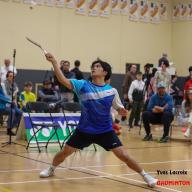
The Art of Deception#
Hi again!
Today I want to write about a concept that I feel hasn’t been talked about or really conceptualized enough in sports, which is deception.
It’s something I’ve come to realize is so important, and honestly something I wish more young players spent time learning early on. Deception naturally develops skills like rhythm, pacing, change of pace, and overall game awareness, things that don’t always show up on a drill sheet, but make a massive difference on court.
I’ll go more in detail throughout this article, but for now, I hope you enjoy the read :)
Introduction - More Than Just “Faking a Shot”#
When people hear deception in sports, they usually think of one thing: faking.
A fake drop, a fake smash, a no-look shot… you name it.
That’s usually where the idea stops.
But deception is way deeper than that, and honestly, much more interesting.
To me, deception is about doing something the opponent doesn’t expect at that exact moment, not just something flashy or fancy-looking. It’s about timing, rhythm, body movement, and how humans naturally react under pressure when things don’t go according to plan. In badminton (and honestly, in almost every sport), deception works best not because the shot itself is special, but because it breaks the opponent’s rhythm.
And once rhythm is broken, everything else starts to fall apart with it.
While these ideas apply to most sports, I’ll focus mainly on badminton here, simply because it’s where my experience comes from and where I’ve personally felt deception make the biggest difference.
Rhythm: The Invisible Structure of Every Rally#
Every athlete moves with rhythm, whether they’re aware of it or not.
In badminton, that rhythm shows up everywhere:
- Footwork patterns
- Split steps
- The tempo of shots
- Even breathing!
When rallies are neutral, both players slowly fall into a kind of flow. You hit, I move, I split, I recover, repeat. After a while, your body starts predicting what comes next without you even consciously thinking about it, and everything feels smoother and easier.
That’s also why, generally speaking, making a point directly on a serve is hard.
The opponent is fully expecting the shot. Their rhythm is clean, their timing is set, and their reaction is proactive rather than rushed.
Deception doesn’t really fight skill.
It fights prediction, and that’s a very different battle.
Why Learning Deception Early Matters#
Deception is especially important for younger players.
When you are learning the game, you’re not just practicing shots — you are learning how the game feels, the pacing, the rhythm, and how speed changes during rallies. Deception naturally teaches all of that, even if you don’t notice it at first.
Without early exposure to deception, many players grow up playing at a single pace, repeating the same drills. They learn clean shots, but everything happens on the same rhythm. Over time, this can create a robotic playing style, where matches feel like extended drills instead of dynamic exchanges.
Experiencing different tempos early lets players experiment, fail, adjust, and learn when deception makes sense. That practice is hard to replicate later if rhythm was never developed.
Over time, this turns into intuition. You start sensing when opponents are rushing or balanced and recognize when holding a shot will hurt more than hitting it fast. You also become better at reacting to deception yourself because you have experienced multiple rhythms instead of just one.
Deception is not just a trick to learn later. It is a tool that builds game intelligence from the very beginning.
An Analogy: Running With a Broken Beat#
Imagine this for a second.
You’re running, and every five steps, you have to stop on one leg.
It’s annoying, sure, but still manageable — because the rhythm is fixed. Your brain adapts pretty quickly and learns when the stop is coming.
Now imagine your coach tells you:
“You still have to stop on one leg… but I’ll tell you randomly when.”
Sometimes after five steps.
Sometimes after three.
Sometimes after one.
Suddenly, everything feels off. Your balance is awkward, your legs hesitate, and instead of just running, you’re constantly thinking about what’s coming next.
That’s deception.
The goal isn’t really to slow the opponent down, it’s to force them out of rhythm entirely, where nothing feels automatic anymore.
How Points Are Actually Won in Badminton#
At the most basic level, winning a point in badminton means one simple thing:
Hitting the shuttle where the opponent can’t reach it on time.
Not where they can’t reach it at all.
Just where they’re a little bit late.
When an opponent is on time:
- Their body stays balanced
- Their recovery feels natural
- Their next shot is controlled
When they’re late:
- Their reaction becomes rushed
- Their recovery turns chaotic
- Their options suddenly shrink
And this is exactly where deception starts to matter.
Deception Works Best When the Opponent Is Already Late#
Deception is most effective when the opponent is already under pressure.
When someone is late, their body momentum is committed in one direction. They rush back to the center, focusing on speed rather than control. Stopping, changing direction, or resetting becomes hard. If you delay your shot at that moment, their body keeps moving while their brain waits.
They cannot split properly.
They cannot decelerate cleanly.
They are forced to react mid-motion.
That brief pause often turns a reachable shot into an impossible one. Even a simple shot can feel unreturnable if played at the right moment. Deception does not need to be flashy here. Interrupting momentum at the wrong time is enough.
This is why breaking an opponent’s rhythm is so powerful. A player moving fast must stop, reprocess, and restart in a fraction of a second. When they are late and overcommitted, they are fully reactive. Reactive players always lose time.
Body Clues and Rhythm Disruption#
Good deception is not just about the racket.
It is about what your body tells the opponent before the shot even happens, often without either of you realizing it.
Every shot leaves information behind. Your opponent does not only react to where the shuttle goes. They adapt to:
- Your posture
- Your arm and shoulder preparation
- Your head position and racket head
- Most importantly, your usual tempo
Over time, a rhythm quietly forms. Not just in footwork, but in when you move, when you load, and when contact happens. Your opponent starts timing their reactions around you.
The Tempo Trap#
Imagine that every time you play a net shot:
- Your arm moves early
- Your preparation is visible
- Contact happens at a predictable moment
After a few exchanges, your opponent no longer waits for the shuttle. They wait for your movement, reacting proactively.
Now change one thing.
You prepare for a net shot, but your arm does not move. Your racket stays still. Your body freezes in what looks like preparation.
When you would normally hit the shuttle, you do not.
That brief delay forces hesitation.
Your opponent pauses.
They cannot fully commit.
They cannot split cleanly.
They are stuck reacting mid-motion.
That discomfort is deception doing its job.
Brain Late, Body Late#
When body cues suggest one rhythm but the shot breaks it, the opponent’s brain falls behind.
Once the brain is late, the body usually follows.
They do not move wrong.
They move late, which is often worse.
This effect is strongest when the opponent is already under pressure.
Deception as a Conversation, Not a Trick#
Deception is not a single action.
It is a conversation across the rally.
You establish rhythm.
You reinforce it.
You let the opponent trust it.
Then, at the right moment, you take it away.
The best deceptive players are patient. They wait for the opponent to adapt first.
Once someone starts moving based on you instead of the shuttle, you are already in control.
Conclusion - Why Deception Is an Art#
Deception isn’t about tricking someone just for fun.
It’s about controlling rhythm, breaking flow, and creating hesitation in ways that give you an advantage. It’s not a win-all tool and doesn’t replace fundamentals like footwork, anticipation, or shot selection.
The best deceptive players pick their moments carefully, using it when the opponent is:
- Rushing
- Late
- Overcommitted
- Mentally locked into a pattern
That’s when deception stops being just a “trick” and becomes a real tool that can shift the balance of a rally.
In a follow-up article, I want to explore the other side of the game: playing against deception, staying stable when rhythm is disrupted, and converting these moments into points. I’ll also cover strategies for winning points, whether using deception or general patterns.
Once you understand how deception works, you’re already halfway there! Not to winning every point, but to playing smarter, feeling the rhythm of the game, and knowing how to respond when things aren’t quite what you expected.
Personally, the more I play with this in mind, the more I notice subtle patterns in my opponents and myself. It’s like a little game within the game, and that’s what keeps me fascinated with badminton after all these years!